



AI is no longer a future consideration for enterprise organizations. It is a present-day strategic priority, one that is appearing on boardroom agendas, shaping technology roadmaps, and influencing investment decisions across industries. Yet for most SAP organizations, the distance between AI ambition and enterprise-scale execution remains significant.
I have spent my career working with SAP organizations on data governance and master data management. In my experience, the challenge is rarely the AI technology itself. It is almost always the data underneath it. The organizations that succeed with AI are not necessarily those with the largest budgets or the most sophisticated technology stacks. They are the ones that have built the right data foundation first.
That is where real AI readiness begins.
For SAP-driven enterprises, good data is not a technical nice-to-have. It is the foundation for reliable automation, confident decision-making, and measurable business value. Without it, AI pilots stall. With it, organizations can accelerate time-to-value, reduce risk, and scale AI with confidence.
New research from ASUG, based on a survey of 142 SAP members from different organizations, confirms what many leaders are experiencing firsthand. Most organizations are actively exploring AI, but very few have moved beyond pilots into deployment that delivers measurable, enterprise-wide value.

The research surfaces five patterns that collectively define where the SAP community stands today.
Most organizations are exploring AI but have not scaled it. Ambition is high across the board but enterprise-wide deployment remains the exception. Integration complexity, change management challenges, and the difficulty of aligning new technology with existing business processes are slowing progress at every level.
The AI investments delivering results are the ones closest to the business. Organizations are prioritizing use cases that improve day-to-day operations and decision-making within existing workflows. The early wins are practical, not experimental and that is a deliberate choice.
Organizational mindset matters more than size or sector. How leadership internally prioritizes and aligns around AI initiatives is a stronger predictor of progress than company revenue, industry, or headcount.
Most organizations cannot yet measure the value they are chasing. Productivity gains, cost reduction, and operational efficiency are the most cited AI objectives yet structured frameworks for assessing whether those outcomes are being delivered remain absent in most organizations.
Governance and readiness are the defining differentiators. Governance, security, and operational alignment have emerged as both the most important enablers of AI expansion and the most common barriers to it.

The pattern across all five findings is consistent: the organizations stalling is not failing because of their AI strategy. They are failing because of what sits underneath it, the data.
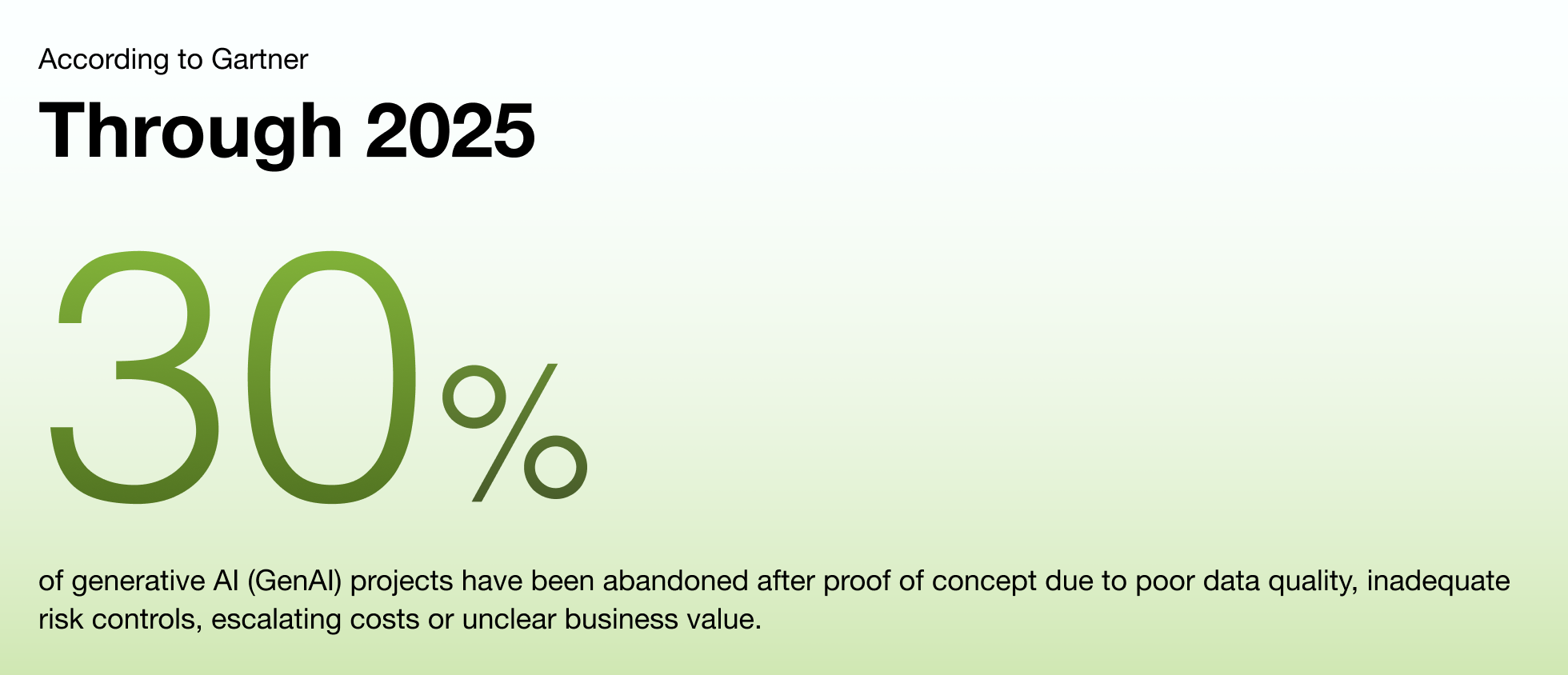
Gartner's research reinforces this at scale. According to Gartner, 30% of generative AI projects will be abandoned after proof of concept due to poor data quality, inadequate risk controls, escalating costs, or unclear business value.
That is not a technology failure. That is a data failure.
However, the business case extends beyond cost. As you move to the cloud and accelerate SAP transformations, clean master data becomes the foundation for:
So what does good look like? What separates an organization that is AI-ready from one that is not?
Gartner defines AI-ready data as data that is representative of the use case, covering every pattern, error, outlier, and unexpected outcome that an AI model needs to operate reliably. Critically, Gartner makes clear that data readiness for AI is not something you build once. It is a continuous practice that is based on the availability of metadata to align, qualify, and govern data on an ongoing basis.

In practical terms within an SAP environment, this means three things.
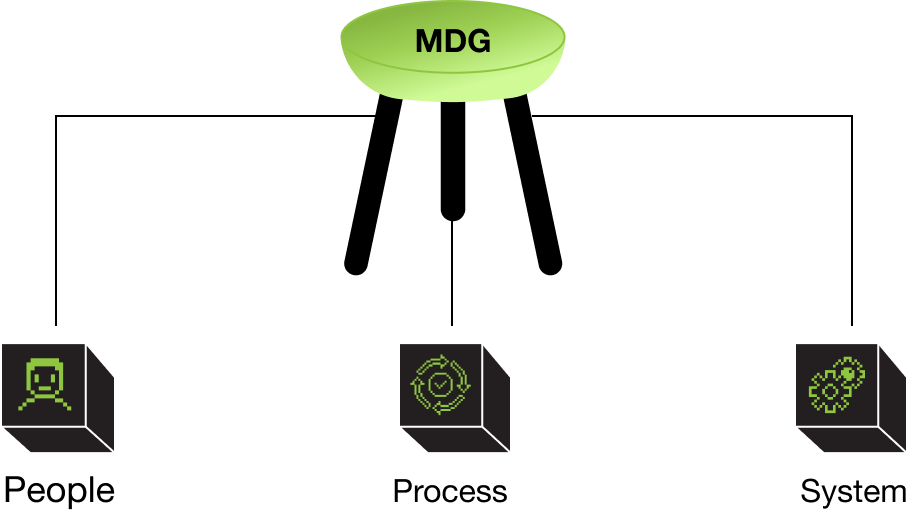
This is the destination. And the distance between where most organizations are today and where they need to be is, in almost every case, a master data governance gap.
Closing that gap requires a structured approach. Based on our work with SAP organizations and informed by Gartner's AI-ready data roadmap, the journey moves through five progressive stages.
Stage 1: Assess your data management readiness.
Your data must be fit for the specific AI use case you are targeting. That means ensuring quality, consistency, semantics, and lineage are in place not as a one-time exercise but as an ongoing standard across every master data object in your SAP landscape.
Stage 2: Gain board-level buy-in.
AI-ready data is not an IT project. It is a business transformation that requires executive sponsorship, clear goals, and organizational commitment. The business case must connect data investment directly to AI outcomes and ultimately to business value.
Stage 3: Evolve your data management practices.
This means moving beyond traditional data management and building the metadata, enrichment, and qualification practices that AI requires. It means treating data readiness not as a project with an end date but as a continuous organizational discipline.
Stage 4: Extend your data management ecosystem.
As AI capabilities mature, so must the supporting data infrastructure. This includes building stronger metadata practices, developing organizational data literacy, and rigorously evaluating the AI-enabled capabilities of your technology vendors.
Stage 5: Scale and govern.
This is where AI-ready data becomes a sustained organizational capability governed by clear roles, processes, and accountability structures, and continuously monitored for quality, compliance, and performance.
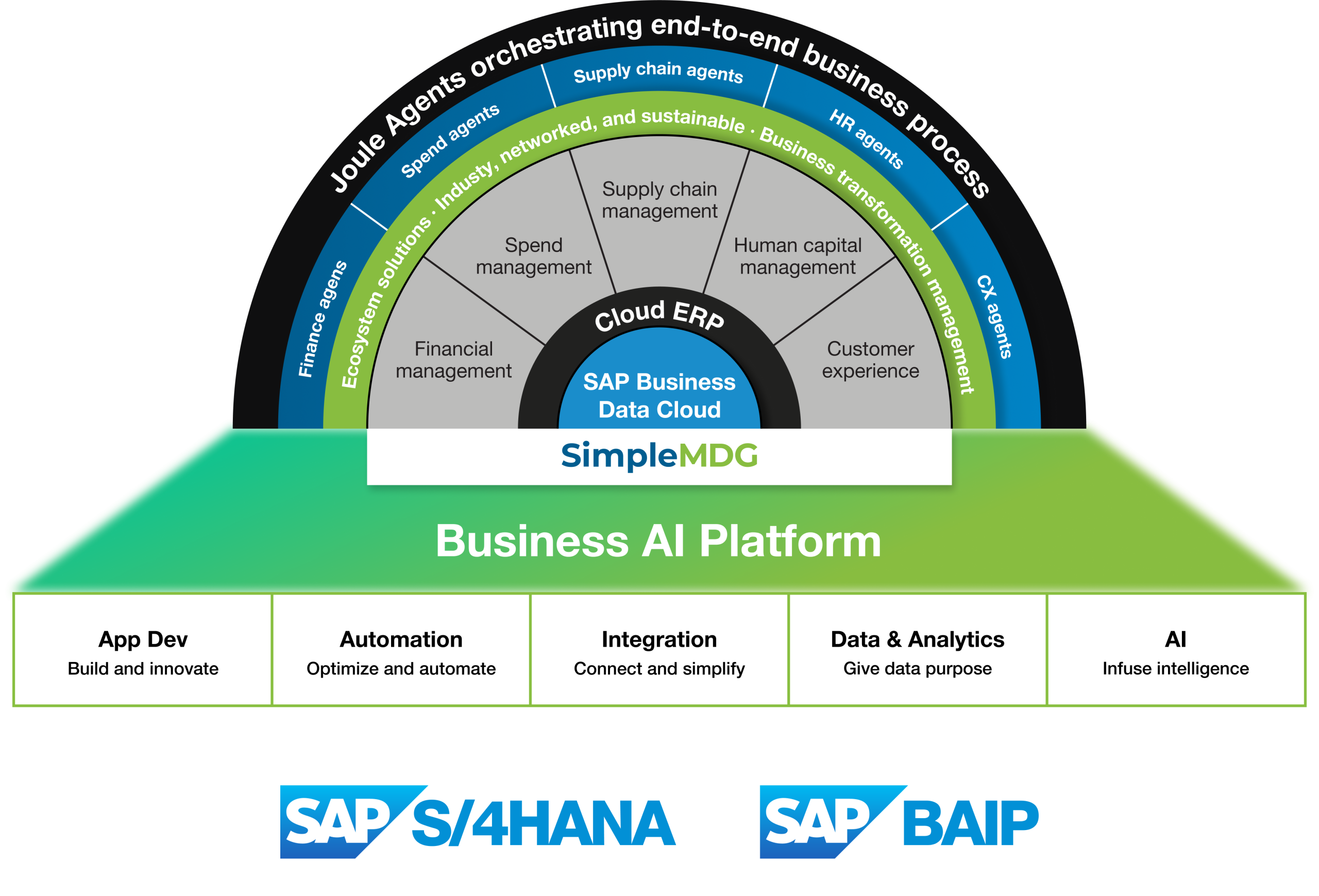
At SimpleMDG, our platform is designed to accelerate every stage of this journey for SAP organizations. As a SAP BTP-native master data governance solution, SimpleMDG provides the Single Version of the Truth that AI depends on — governing master data across your entire SAP landscape with the simplicity, flexibility, and depth that enterprise organizations require.
Our approach aligns with SAP's three core principles of Business AI: relevant, reliable, and responsible. Relevant because SimpleMDG operates natively within the SAP BTP ecosystem, ensuring AI always has full business context. Reliable because governed master data produces consistent, trustworthy AI outputs. And responsible because SimpleMDG's governance framework ensures AI operates within your organization's security, compliance, and ethical standards.
Many MDG tools promise automation but remain complex, IT-heavy, and costly. SimpleMDG changes that equation with a business-led, self-serve approach that accelerates time-to-value.
With SimpleMDG, SAP enterprises get a faster, more intuitive, and more cost-effective path to trusted master data ready for S/4HANA and future growth.
The gap between AI ambition and AI execution is real, but it is solvable. Organizations do not need more disconnected pilots. They need a stronger data foundation. The enterprises that will lead with AI over the next three years will not simply be the ones investing the most in models or tools. They will be the ones investing in trusted master data, scalable governance, and business-ready foundations that make AI work in the real world. For every SAP leader, the question is no longer whether AI matters.
The real question is whether your data is ready!